Lists and Indexing
A value that holds other values
Breaking Changes
length becomes a keyword.
[ and ] are now reserved for list literals
and indexing.
List Literals
empty = [];
mixed = [1, "two", true];
Elements do not need to share a type.
Reading by Index
numbers = [10, 20, 30];
print(numbers[1]);
Prints 20. An index is a position, not the
element.
Index Typing
if type(index) is bool or type(index) not in (int, float):
    raise TypeError("List index must be an integer")
if type(index) is float and not index.is_integer():
    raise TypeError("List index must be an integer")
3.0 is valid. 3.5 and
true are not.
Chained Indexing
matrix = [[1, 2], [3, 4], [5, 6]];
print(matrix[1][0]);
Prints 3. No special two-argument
form.
Traversal with While and Length
values = [3, 1, 4, 1, 5, 9];
total = 0;
i = 0;
while (i < length(values)) {
    total = total + values[i];
    i = i + 1;
}
total ends at 23.
Parsing: List Literals and Postfix Chains
def parse_complex_suffixes(node, tokens):
    while tokens[0]["tag"] == "[":
        index, tokens = parse_expression(tokens[1:])
        tokens = require(tokens, "]", "Expected ']' after index")
        node = {"tag": "complex", "base": node, "index": index}
    return node, tokens
Evaluating an Index Read
if ast["tag"] == "complex":
    base, status = evaluate(ast["base"], environment)
    if status is not None:
        return base, status
    index, status = evaluate(ast["index"], environment)
    if status is not None:
        return index, status
    if type(base) is not list:
        raise TypeError("Indexing requires a list")
    return base[require_list_index(index, base)], None
Indexed Assignment
assignment_statement ::= <identifier> { index_suffix } "=" expressionSame grammar helper as reading. The difference is only in what the evaluator does with the result.
Evaluating Indexed Assignment
elif target["tag"] == "complex":
    base, status = evaluate(target["base"], environment)
    if status is not None:
        return base, status
    index, status = evaluate(target["index"], environment)
    if status is not None:
        return index, status
    if type(base) is not list:
        raise TypeError("Indexed assignment requires a list")
    key = require_list_index(index, base)
    destination = base
The Evaluation Order
The target is resolved before the right-hand value, for every kind of target.
a[exit(6)] = exit(999);Returns (6, "exit"), not (999, "exit").
Mutation and Rebinding
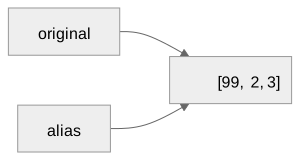
original = [1, 2, 3];
alias = original;
alias[0] = 99;
print(original);
Prints [99, 2, 3]. No new code made this
possible.
Two Names, One List
Rebinding Is Different
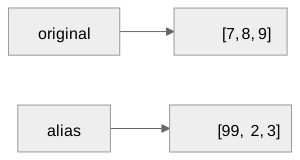
original = [7, 8, 9];
print(alias);
Still prints [99, 2, 3].
Rebinding Redirects One Name
Equality
print([1, 2] == [1, 2]);
print([true] == [1]);
Prints true, then
false.
Concatenation
first = [1, 2];
second = [3, 4];
combined = first + second;
combined[0] = 99;
print(first);
Prints [1, 2]. combined is a new
list.
Printing and Conversions
print([1, "hi", true, [2, 3]]);Prints [1, "hi", true, [2, 3]].
Testing the Contract
Empty and mixed-type literals; element evaluation order; nested literals and chained indexing.
Every rejected index case: fractional, boolean, string, negative, out of range.
Mutation through an alias versus rebinding leaving the alias untouched; structural equality including the nested true != 1 case.
exit injected at every new position: a list element, an index base, an index, and an indexed assignment’s right-hand value.
Questions for Thought
When should assigning a list copy it, and when should it share the same value?
How can the scalar equality rule true != 1 affect the equality of two lists that look identical at a glance?
What state can change before an indexed assignment encounters exit, and what can only change after it?