Logical Operators
Truth values, precedence, and short-circuit evaluation
Breaking Changes
New keywords: and, or,
not
Rename earlier variables that use those exact names.
android, origin, and notable
remain identifiers.
Combining Comparisons
__input = "21";
answer = number(input()) * 2;
in_range = answer >= 40 and answer <= 50;
print(in_range);
Two comparisons; one boolean result: true.
Two Spellings, One Tag
| Source | Token tag |
|---|---|
and, && |
and |
or, || |
or |
not, ! |
not |
Normalize in the tokenizer.
Boolean Operations
| Left | Right | and |
or |
|---|---|---|---|
false |
false |
false |
false |
false |
true |
false |
true |
true |
false |
false |
true |
true |
true |
true |
true |
not true is false; not false
is true.
Precedence Changes the Tree
not x == y      means   not (x == y)
a or b and c    means   a or (b and c)
Weakest to strongest:
or, and, not, comparisons,
arithmetic
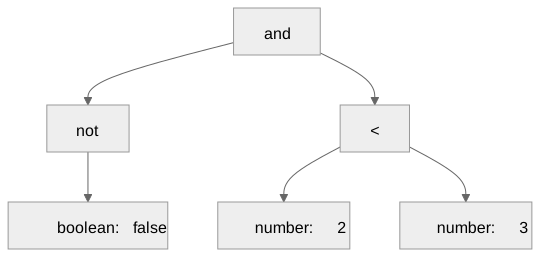
The Expression Tree
not false and 2 < 3
Parser Levels
expression ::= logic_or
logic_or ::= logic_and { "or" logic_and }
logic_and ::= logic_not { "and" logic_not }
logic_not ::= "not" logic_not | comparison
Each level calls the next tighter level.
One Comparison at a Time
1 < 2 < 3             rejected
1 < 2 and 2 < 3       true
(1 < 2) == true       true
Parentheses settle grouping, not operand types.
A Guard Before Division
divisor = 0;
safe = divisor != 0 and 10 / divisor > 2;
print(safe);
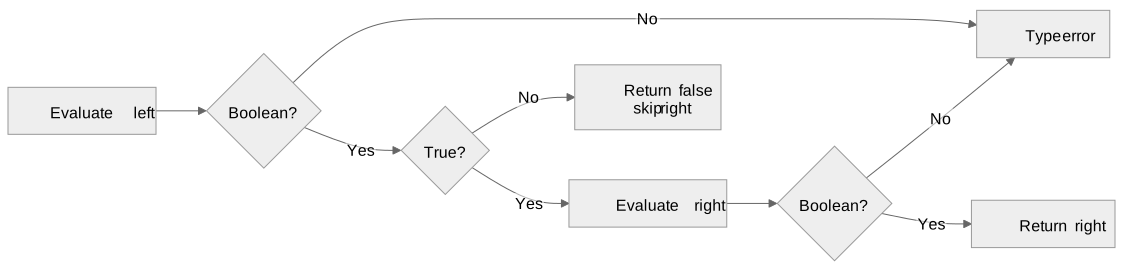
The division never runs.
Short-Circuit and
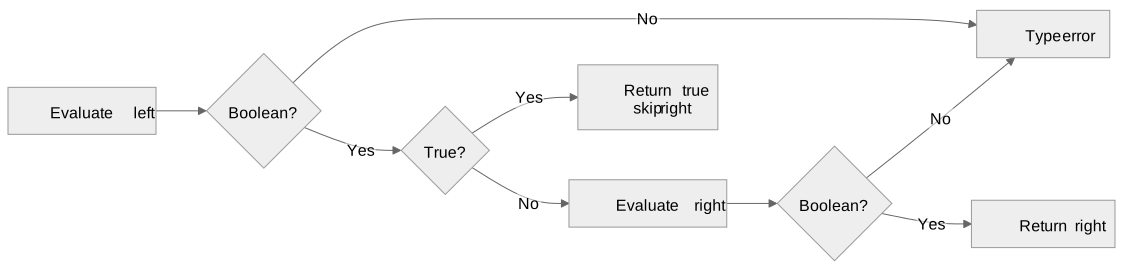
Short-Circuit or
Input That Does Not Run
__input = "ready";
result = false && input() == "ready";
print(result);
print(__input);
false
readySkipped Does Not Mean Unparsed
| Expression | Behavior |
|---|---|
false and missing |
false |
false and 42 |
false |
true and 42 |
Type error |
false and (1 +) |
Syntax error |
Checking the Implementation
bash run-tests.shSame tokens and trees for both spellings.
Truth tables, precedence, skipped input, required input.
Practice
Accept a supplied number from 10 through 20, inclusive.
Then compare these two expressions:
divisor != 0 and 10 / divisor > 2
10 / divisor > 2 and divisor != 0
When does changing the order change the behavior?