Simple Expressions in Vertex
How 3+4*5 becomes 23
Running Vertex
./vertex '3+4*5'23Or read the supplied expression: ./vertex example.v
The Interpreter’s Stages
| Stage | Input | Output |
|---|---|---|
| Tokenizer | Characters | Tokens |
| Parser | Tokens | Expression tree |
| Evaluator | Expression tree | Value |
tokens = tokenize(expression)
ast = parse(tokens)
result = evaluate(ast)
Tokenizing 3+4*5
| Tag | Value | Column |
|---|---|---|
number |
3 |
1 |
+ |
2 | |
number |
4 |
3 |
* |
4 | |
number |
5 |
5 |
None |
6 |
Recognizing a Number
r"\d*\.\d+|\d+\.\d*|\d+"| Alternative | Example |
|---|---|
\d*\.\d+ |
.5, 12.5 |
\d+\.\d* |
5. |
\d+ |
123 |
The tokenizer tries patterns at the current position.
Recognize and Discard Comments
8 / 2 // Divide eight by two.(r"//[^\r\n]*", "comment"),Match comments before division.
if current_tag not in ("whitespace", "comment"):The parser sees only 8 / 2.
Tokens Carry Values
{"tag": "number", "line": 1, "column": 1, "value": 3}if token["tag"] == "number":
if "." in value:
token["value"] = float(value)
else:
token["value"] = int(value)The text "3" becomes 3; "12.5"
becomes 12.5.
Vertex’s Expression Grammar
expression ::= term { ("+" | "-") term }
term ::= unary { ("*" | "/") unary }
unary ::= "-" unary | factor
factor ::= <number> | "(" expression ")"
Extended Backus-Naur Form (EBNF)
Braces repeat. A vertical bar separates alternatives.
The Tree for 3+4*5
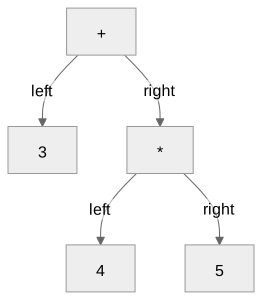
The right subtree supplies 20 to the addition.
Parsing a Factor
if token["tag"] == "number":
    node = {"tag": "number", "value": token["value"]}
    return node, tokens[1:]
Input: 3 + 4
Returned node: 3
Remaining tokens: + 4 and the end marker
Parentheses Re-enter the Grammar
if token["tag"] == "(":
    node, tokens = parse_expression(tokens[1:])
    if tokens[0]["tag"] != ")":
        raise SyntaxError(f"Expected ')', got {tokens[0]}")
    return node, tokens[1:]
(3+4)*5 groups the addition first.
Building a Term
left, tokens = parse_unary(tokens)
while tokens[0]["tag"] in ["*", "/"]:
    op = tokens[0]["tag"]
    right, tokens = parse_unary(tokens[1:])
    left = {"tag": op, "left": left, "right": right}
return left, tokens
3*-2 parses as multiplication with a negated right
operand.
Unary Minus
if tokens[0]["tag"] == "-":
    operand, tokens = parse_unary(tokens[1:])
return {"tag": "unary-", "operand": operand}, tokens-5, 3*-2, and -(3+4) all use
the same rule.
Requiring the Whole Expression
ast, tokens = parse_expression(tokens)
if tokens[0]["tag"] is not None:
    raise SyntaxError(f"Unexpected token: {tokens[0]}")
return ast
3 4 must fail after the parser reads 3.
Evaluating the Tree
if ast["tag"] == "number":
    return ast["value"]
elif ast["tag"] == "+":
    return evaluate(ast["left"]) + evaluate(ast["right"])
elif ast["tag"] == "*":
    return evaluate(ast["left"]) * evaluate(ast["right"])
elif ast["tag"] == "unary-":
    return -evaluate(ast["operand"])
For 3+4*5: the children supply 3 and
20.
Where an Expression Fails
| Input | Failure | Stage |
|---|---|---|
3@4 |
Unrecognized character | Tokenizer |
3+*4 |
Missing operand | Parser |
(3+4 |
Missing closing parenthesis | Parser |
3 4 |
Extra token | Parser |
3/0 |
Division by zero | Evaluator |
Unit Tests in Python
python3 tokenizer.py
python3 parser.py
python3 evaluator.py
Vertex has no output or assertions yet.
Python unit tests check its implementation.
Following a Wrong Result
Tokens: Did we recognize the intended values?
Tree: Did we group the operations correctly?
Evaluation: Did each node compute the right value?
Inspect the intermediate result before changing the code.