Optimization
From fruit and state to millions of titles
The Small Table
create table fruitsforsale (
    fruit text, state text, price real
);
Seven rows. Oranges from Florida and California.
Follow the rows through the SQLite illustrations.
A Full Table Scan
select price from fruitsforsale
where fruit = 'Peach';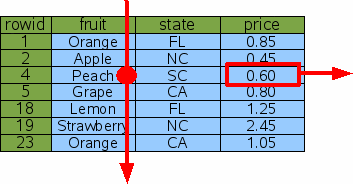
Time grows with N.
Lookup by Rowid
select price from fruitsforsale
where rowid = 4;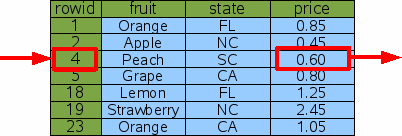
Time grows with log N.
An Index
create index Idx1 on fruitsforsale(fruit);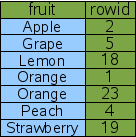
A sorted copy of a column, plus rowids.
Using an Index
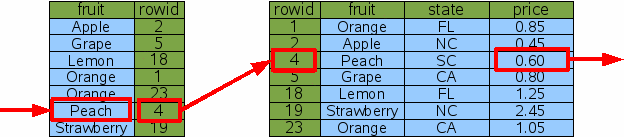
Two binary searches: the index, then the table.
Reading a Query Plan
explain query plan
select price from fruitsforsale
where fruit = 'Peach'| Plan text | Meaning |
|---|---|
SCAN fruitsforsale |
Read every row |
SEARCH ... USING INDEX |
Find rows by index |
... COVERING INDEX |
Index alone answers |
USE TEMP B-TREE FOR ORDER BY |
Sort step |
Look for SCAN first.
Two Conditions
select price from fruitsforsale
where fruit = 'Orange' and state = 'CA';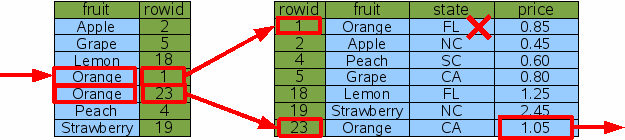
Find the oranges. Check their states.
A Multi-Column Index
create index Idx3 on fruitsforsale(fruit, state);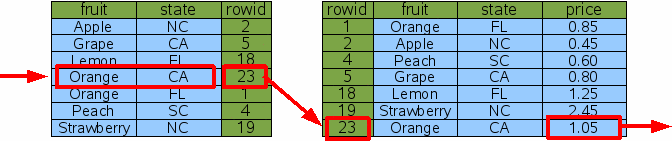
Fruit first; state breaks ties.
A Covering Index
create index Idx4 on fruitsforsale(fruit, state, price);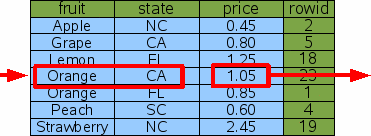
The index contains the answer: price.
OR
select price from fruitsforsale
where fruit = 'Orange' or state = 'CA';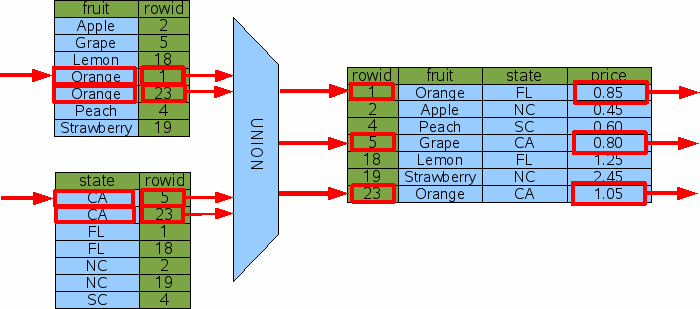
Combine matches; return each matching row once.
Sorting
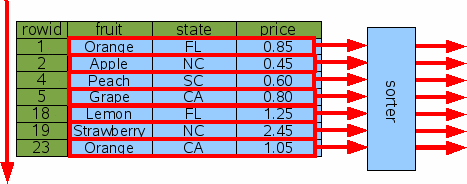
Collect every row, then sort: K log K, plus temporary storage.
Sorting with an Index
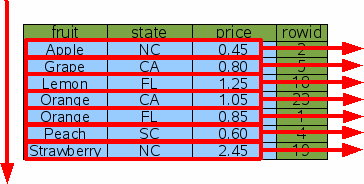
An index is already in order.
Search and Sort Together
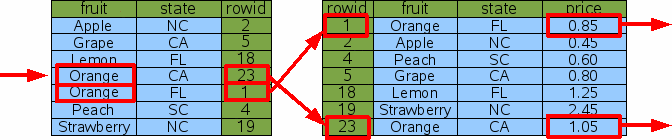
where fruit = 'Orange' order by state, with an index on
(fruit, state).
Partial Sort
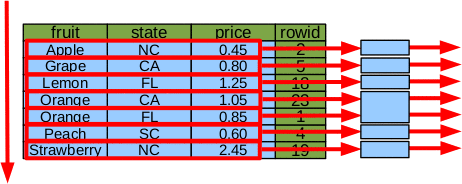
order by fruit, price: the index gives fruit order;
SQLite sorts within each fruit.
Statistics
analyze;SQLite picks among indexes by estimated selectivity.
Without statistics, the choice is close to arbitrary.
It also makes a skip-scan possible.
Real Data
| File | Rows |
|---|---|
title.basics |
12,811,750 |
title.ratings |
1,713,431 |
Gzip-compressed tab-separated values (TSV). Missing value:
\N.
Personal and non-commercial use only.
Keep the Data Out of Git
Before downloading, add to the root
.gitignore:
**/data/
**/imdb.db
**/imdb.db-*
Commit the code and .gitignore. Keep the data local.
Check: git check-ignore -v data/title.basics.tsv.gz
Get Your Own Titles Database
IMDb supplies two compressed data files.
The course supplies import_imdb.py and
schema.sql.
- Download
title.basics.tsv.gzandtitle.ratings.tsv.gzintodata/. - Run
python3 import_imdb.pyin the code folder. - Open the resulting
imdb.db.
The loader reads local files; it does not download them.
Loading in Chunks

12.8 million rows in 54 seconds. No secondary indexes yet.
One Index, One Query
select tconst, start_year from titles
where primary_title = 'The Godfather'| Plan | Time | |
|---|---|---|
| No index | SCAN titles |
4,536 ms |
create index ... (primary_title) |
SEARCH ... USING INDEX |
under 0.1 ms |
47 titles are called “The Godfather”.
What an Index Costs
| Index | Build | Size added |
|---|---|---|
primary_title |
18.4 s | 381 MB |
title_type, start_year |
16.4 s | 263 MB |
title_type, start_year, primary_title |
30.5 s | 536 MB |
ratings(num_votes) |
0.7 s | 18 MB |
500,000 inserts: 0.25 s with no index, 0.37 s with one, 1.06 s with three.
Two Conditions on Titles
select count(*) from titles
where title_type = 'movie' and start_year = 1994;| Index | Time |
|---|---|
| No useful index | 4,435 ms |
start_year |
37.7 ms |
(title_type, start_year) |
0.1 ms |
Column Order Matters
| Conditions | Index used |
|---|---|
title_type |
First column |
title_type and start_year |
Both columns |
start_year alone |
None, before analyze |
start_year alone: full walk of the index, 432 ms.
After analyze: skip-scan, 1.9 ms.
title_type alone: search, 18 ms.
Covering a Titles Query
select primary_title ... where title_type = ? and start_year = ?
| Time | |
|---|---|
| Two-column index | 5.0 ms |
| Covering index | 1.4 ms |
OR on Titles
select tconst from titles
where start_year = ? or primary_title = ?| Time | |
|---|---|
| One term unindexed | 4,568 ms |
| Both indexed | 0.1 ms |
LIKE
| Query | Index | Time |
|---|---|---|
like 'The Godfather%' |
Ordinary | 4,669 ms, scan |
like 'The Godfather%' |
collate nocase |
0.2 ms |
like '%Godfather%' |
Ordinary or nocase |
5,024 ms, scan |
A wildcard at the front cannot use an ordinary index.
Top Ten by Votes
select tconst, num_votes from ratings
order by num_votes desc limit 10| Plan | Time | |
|---|---|---|
| No index | SCAN + TEMP B-TREE |
77 ms |
Index on num_votes |
SCAN ... USING INDEX |
under 0.1 ms |
The plan still says SCAN. The sort is gone, and limit
stops the walk.
Python or SQL?
| Time | |
|---|---|
| 2,000 queries, one per title | 148 ms |
| One join | 10 ms |
| Fetch 643,991 years, count in Python | 263 ms |
group by in SQL, 15 rows |
164 ms |
Measure.
Stored Procedures
create or replace procedure
    change_owner(pet integer, new_owner text)
language plpgsql
as $$ ... $$;

call change_owner(1, 'Sam');
One call: read, update, log.
SQLite has none. This is PostgreSQL.
Choosing Indexes
Start from the queries.
Index what you search, join, and sort by.
Equality columns first, range columns last.
Drop an index that starts another.
Read the plan, then measure.
Exercise: Tune Three Queries
Longest movies over 300 minutes.
Titles rated 9.5 or higher with 10,000 or more votes.
Average rating of movies by decade.
Read the plan. Predict the index. Check.