Object-Relational Mappers
The pet database layer, implemented with Peewee
The Route’s Interface
data = database.get_pet(id)Input: a pet identifier
Output: a dictionary, or None
The implementation now uses an object-relational mapper (ORM).
A Lookup Through Peewee
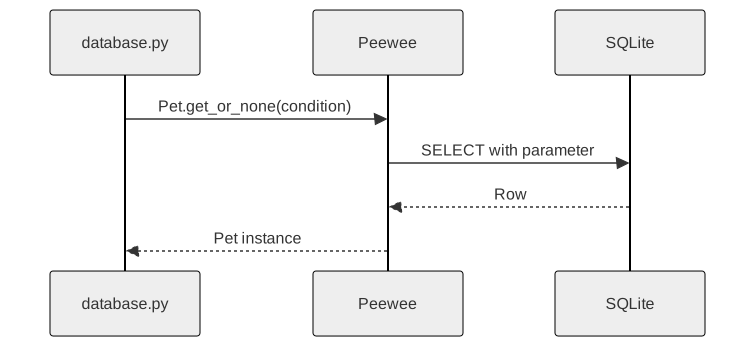
Peewee generates Structured Query Language (SQL).
Running the Example
python3 -m pip install -r requirements.txt
flask run
http://127.0.0.1:5000/list
Setup also runs separately:
python3 setup_database.py
The Pet Model
class Pet(BaseModel):
    name = TextField(null=False)
    type = TextField(null=False)
    age = IntegerField(default=0)
    food = TextField(null=True)
Peewee supplies the integer primary key,
id.
Class, Field, Instance
| Expression | Meaning |
|---|---|
Pet |
Model class for the table |
Pet.name |
Field used to build a query |
pet.name |
Name on one instance |
pet.id |
Identifier of that pet |
Pet describes records. pet holds
one record’s values.
Connecting the Model
db = SqliteDatabase(None)

class BaseModel(Model):
    class Meta:
database = dbdb.init("pets.db")
db.connect(reuse_if_open=True)
db.create_tables([Pet])Reading the List
def get_pets():
    query = Pet.select().order_by(Pet.name, Pet.id)
    return [pet_to_dict(pet) for pet in query]
Query construction:
select().order_by(...)
Execution: iteration over query
Reading One Pet
pet = Pet.get_or_none(Pet.id == int(id))
if pet is None:
    return None
return pet_to_dict(pet)
Pet.id == int(id) builds a SQL
condition.
Returning a Dictionary
def pet_to_dict(pet):
    return {
        "id": pet.id, "name": pet.name,
        "type": pet.type, "age": pet.age,
        "food": pet.food,
    }
The templates keep using pet['food'].
Creating a Pet
def create_pet(data):
    pet = Pet.create(**_pet_values(data))
return pet.idPet.create(name="Casey", type="dog",
age=9, food="kibble")create() inserts and returns the saved
instance.
Updating Casey’s Food
database.update_pet(10, {
    "name": "Casey", "type": "dog", "age": "9",
    "food": "chicken"
})| Record | Before | After |
|---|---|---|
Casey, id=10 |
food="kibble" |
food="chicken" |
Executing the Update
Pet.update(**_pet_values(data)).where(
    Pet.id == int(id)
).execute()| Part | Job |
|---|---|
update(...) |
Replacement values |
where(...) |
Which pet |
execute() |
Run the statement |
Deleting One Pet
Pet.delete().where(Pet.id == int(id)).execute()The condition selects the record.
The execution performs the deletion.
Object Changes and Saved Values
pet.food = "chicken"| Action | Object’s food | Stored food |
|---|---|---|
| Load Casey | kibble | kibble |
Assign pet.food |
chicken | kibble |
Call pet.save() |
chicken | chicken |
Grouping Writes
with database.db.atomic():
    database.create_pet(casey_data)
    database.create_pet(heidi_data)
Successful block: commit both.
Exception escaping the block: roll back both.
Inspecting the SQL
query = Pet.select().where(Pet.type == "cat")
statement, parameters = query.sql()
print(statement)
print(parameters)
Where is the condition? Where is the value?
Testing Persistence
python3 database.py
python3 -m unittest -v| Check | What it establishes |
|---|---|
| Close, reopen, read | Values reached the database |
| Assign, read, save, read | When object changes persist |
Raise inside atomic() |
Grouped writes roll back |
What Should Cross the Boundary?
get_pet(id) could return a dictionary or a Peewee
instance.
What changes for the caller?
Keep the return contract explicit when changing the implementation.